

What Happens When an AI Agent Shops for You
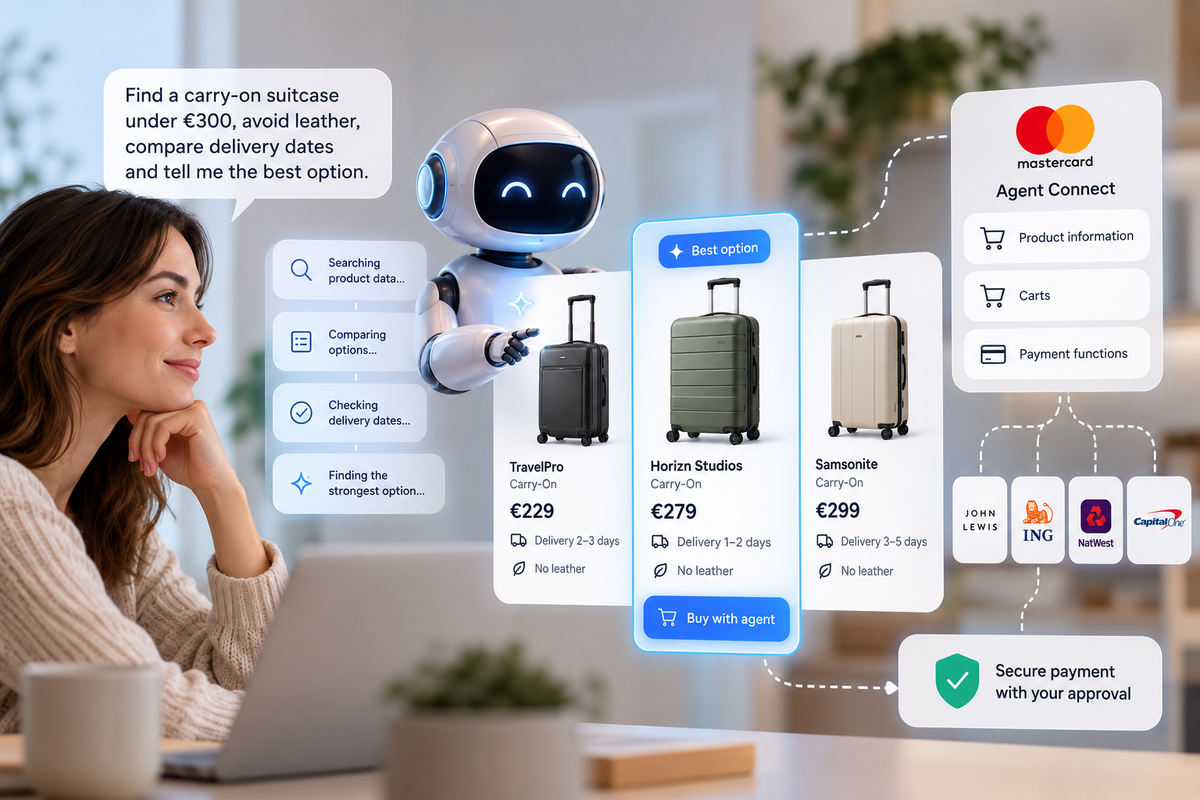
AI agents are moving from product recommendations towards purchases. Mastercard’s Agent Connect gives merchants a way to expose product information, carts and payment functions to approved AI agents. Retailers keep control over prices, fulfilment and commercial rules. The technology removes one step from online shopping. A customer no longer needs to search every store personally.
Your agent starts with an instruction
A shopper can ask software to find a carry-on suitcase under €300, avoid a specified material, compare delivery dates and identify the strongest option. The agent searches product data instead of waiting for the customer to visit individual websites. Retailers then compete inside the agent’s comparison.
Product descriptions, availability, delivery terms and final price become machine-readable sales information rather than material designed only for a person browsing a page. A merchant with poor product data can lose the sale before the customer ever sees its website.
Buying introduces a harder question than searching
Finding a product carries limited financial risk. Paying for one requires permission. Banks want to know when software acts on behalf of a customer, what authority the customer gave it and how disputed transactions will be handled.
NatWest, Bank of America, ING and Capital One have raised concerns around fraud, scams and access to financial information as shopping agents gain transaction functions.
Retailers also need boundaries. Did the shopper approve one product or any product below €300? Can the agent substitute another brand? Can it accept a higher delivery fee to meet a deadline? Who handles the return if the agent selected the wrong item?
Merchants decide how far the agent gets
A retailer does not have to hand over the entire checkout. It can expose catalogue information while requiring the customer to approve payment. It can accept selected agents and reject unknown ones. It can set rules around prices, substitutions and fulfilment.
Agent traffic is already becoming visible. John Lewis reported AI-originated searches rising from 0.3 percent to 2.5 percent within a year.
For retailers, the next decision is no longer whether people use AI to find products. They already do. The decision is which parts of search, selection and payment a merchant allows software to complete without sending the customer back to the conventional checkout.